
Agroecology: A Way Out of the Hunger & COVID-19 Crisis
Rural peoples around the globe are suffering from increased hunger and poverty due to unprecedented challenges brought on by the COVID-19 pandemic. The World Food Programme estimates that the number of people facing acute hunger stands to rise to 265 million this year, up by 130 million from 2019, as a result of the economic impact of COVID-19. Loss of jobs and incomes across all sectors have especially impacted the poorest and most marginalised ones—small farmers, agricultural workers, fisherfolk, indigenous peoples, women and youth. Food producers, despite having proven to be among the world’s most essential and industrious workers, remain among the most vulnerable and food insecure throughout the pandemic.
Dominant food systems under monopoly capitalism, which places profit above all, is constantly engaged in massive environmental destruction and toxic contamination of ecosystems. The ecological imbalance caused by decades of unsustainable agricultural practices is widely acknowledged to have contributed to the rise of novel pathogens such as COVID-19. Moreover, the food and agriculture system has failed to “feed the world” purely through profit-motivated technological means—the use of commercial high-yielding crop varieties, genetically-engineered seeds, and hazardous pesticides controlled by a handful of corporations. Instead, these products have ultimately disempowered, debilitated the health and quality of life, and indebted food producers, as well as resulted to the alarming loss of traditional seeds and biodiversity.
More and more rural peoples are losing their rights and access to land and natural resources, mostly due to land grabbing for export-oriented cash crop plantations and environmentally destructive projects, which destroy livelihood sources and cultures and undermine the right to food of entire communities and nations, especially in the Global South. Neoliberal policies have undermined local and sustainable food production and consumption in order to cater to demands by richer countries or big industries—the folly of this has been exposed during the pandemic, with millions of rural people put out of work or paid starvation wages due to the closure of factories or the shrinking of demand in industries affected by the crisis.
Before the pandemic, many of the rural youth have been compelled to migrate to urban areas due to low wages in agricultural industries, or to earn extra income for farming families who are perpetually in debt. With the COVID-19 crisis, many have been forced back into their villages, creating a stress on already weak and underdeveloped rural economies.
The COVID-19 pandemic has placed a harsh spotlight on how existing systems—including food systems—have miserably failed in upholding and providing for the most basic rights and needs of the people. It has plunged the world into recession, but has also placed people and movements on the cusp of change. Even before the pandemic, there has been growing recognition that a food systems approach to food security is needed to solve world hunger, reinforced by the UN’s announcement last year of a Food Systems Summit. But agro- corporations have either been hijacking calls for radical shifts in policy, or using food security issues highlighted by the pandemic to further consolidate their control over food and agriculture.
It then behooves CSOs and people’s movements to make sure that the demands of rural peoples for food and rights amid the pandemic are heard and realised. Now is also the best opportunity to push for genuine food systems change, and agroecology as an economically viable and socially just approach to sustainable agriculture and food systems for which the energies of the rural youth can be harnessed.
Agroecology, grounded in the integration of science with local and indigenous knowledge and practice, emphasises farming in harmony with natural cycles and processes. Together with people’s food sovereignty —which includes the right to land and the right to produce and access safe, nutritious, and culturally appropriate food—as the bedrock of food systems change, agroecology can be one of the ways forward and out of the hunger crisis.
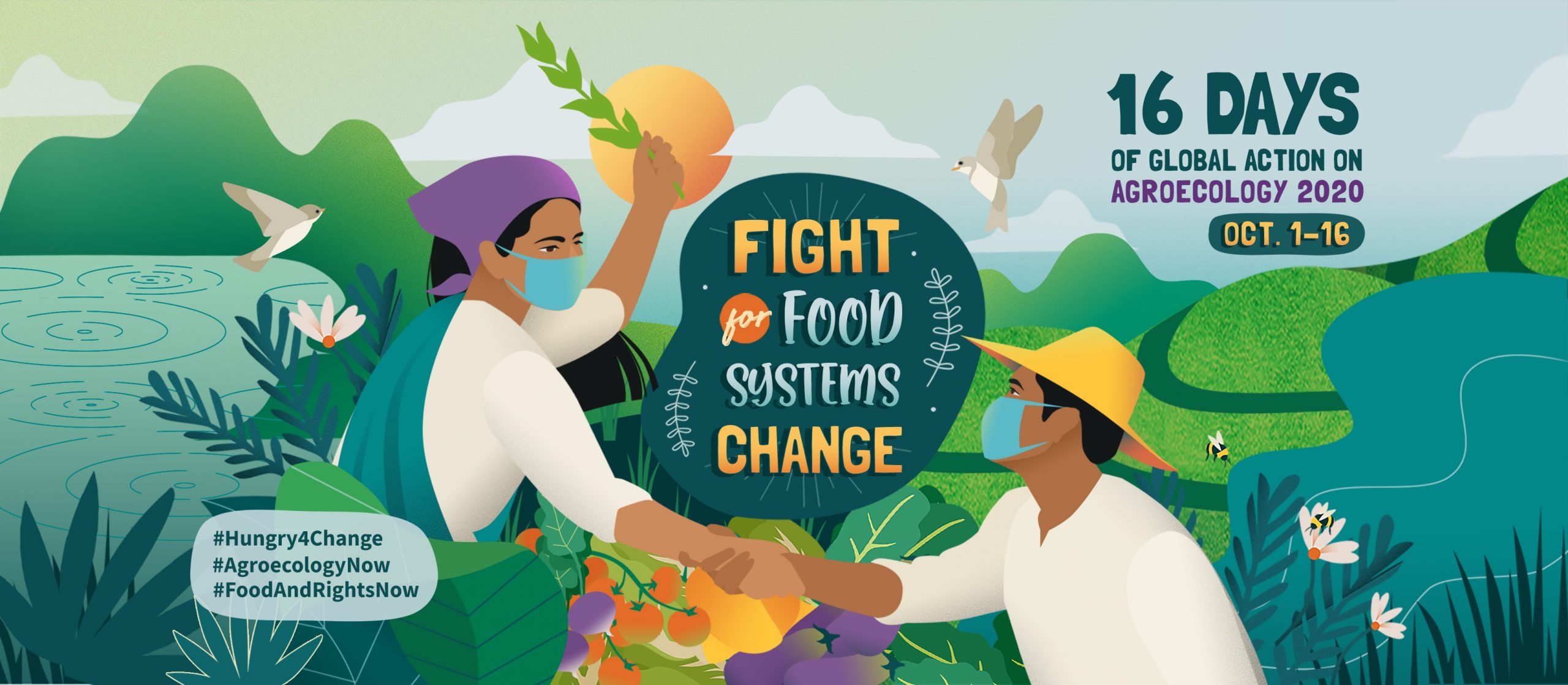
16 Days of Global Action on Agroecology 2020: #Hungry4Change
Since 2016, PAN Asia Pacific (PANAP) and its partner organisations have been conducting the 16 Days of Global Action on Agroecology from 1-16 October as a series of collective actions to advance agroecology and people’s food sovereignty. This year, to reflect the current situation amid the COVID-19 pandemic, the theme will be “16 Days of Global Action on Agroecology 2020: Fight for Food Systems Change!” It will be held as part of the global #Hungry4Change campaign, which aims to advance the right to just, equitable, and sustainable food systems. It will culminate on October 16, commemorated by the Asian Peasant Coalition and rural peoples the world over as World Hunger Day, in conjunction with the UN FAO’s World Food Day.
Through the 16 Days of Global Action, we aim to:
(1) Popularise and advance the call for agroecology as an alternative to chemical- intensive, corporate-controlled agriculture and as a means to achieve food security and people’s food sovereignty;
(2) Promote the youth’s initiatives and leadership role in the movement for agroecology;
(3) Raise the various demands of rural people for food and rights amid the COVID-19 pandemic;
(4) Expose and resist the various ways in which corporations are using the pandemic to further consolidate their control over food and agriculture; and
(5) Push for immediate and long-term food and agriculture policy changes at the local, national, regional and international levels towards achieving more just, equitable, and sustainable food systems.
What can you do to join the 16 Days of Global Action 2020?
(1) Organise a collective action or activity any day from October 1 to 16 zeroing in on the demands of rural peoples for food and rights amid COVID-19, for food and agriculture policy changes to address hunger, or for agroecology. You can link up with other organisations of farmers, agricultural workers, fisherfolk, indigenous peoples, women, youth, professionals, the academe, or similar advocacy groups in your respective countries.
Activities or actions may include, or be a combination of, the following:
- Taking photos and videos on the impact of COVID-19 on rural peoples and their urgent demands and aspirations (documentation)
- Relief and solidarity missions to communities in need
- Consultation and dialogues with policymakers
- Workshops and trainings
- Collective farming
- Community discussions or meetings/assemblies
- Public forum
- Mass mobilisations (public rallies, demonstrations, marches, boycotts, etc.)
- Traditional seed festival or exchange
- Community food markets
- Cultural events (community theater, collective dancing, art workshops, cooking demos, etc.)
- Mass distribution/dissemination of informational/educational materials
Depending on the situation and existing protocols in each country, activities can be done both online and offline.
(2) Partners in different countries can focus on a range of issues, and from these, carry out their own country-specific campaigns for the 16 Days of Global Action 2020. Issues and campaigns may include:
- Impacts of the COVID-19 pandemic on food security and rural peoples and their urgent demands and aspirations
- Ecological crisis and the role of agroecology in protecting or restoring biodiversity and traditional and local seeds and knowledge systems, etc.
- Awareness raising on the health, environmental, and social impacts of hazardous technologies such as pesticides and GMOs
- Policy advocacy towards more just, equitable, and sustainable food systems e.g. promotion of agroecology, ban on pesticides and GMOs, agricultural workers’ safety and welfare
- Highlighting the role of women and youth in the movement for agroecology
- Asserting rights to land, water and resources
- Resisting neoliberal policies in agriculture that impact small food producers
- Safeguarding human rights of rural peoples amid the COVID-19 pandemic
If your organisation is conducting an activity related to the theme from Oct 1-16, you can include it in the campaign by using the 16 Days poster and flyer (you can add your organisation’s logo), or by sharing photos of your activity with our hashtags: #AgroecologyNow #Hungry4Change #FoodAndRightsNow
(3) Participate in an online campaign
- Use the 16 Days of Global Action profile frame and cover photo on your Facebook accounts, you may download them.
- Share a photo of yourself holding a placard (or any other object!) with one or all of our calls:
Fight for food systems change!
Agroecology now!
Uphold people’s food sovereignty! - Share a video of yourself answering one or both of the following questions:
What is the change in the food and agriculture system you would like to see?
Amid the COVID-19 pandemic, why is there a need for agroecology? - Share other articles, photos, videos or thoughts on social media related to the theme, and use any of our official hashtags: #AgroecologyNow #Hungry4Change #FoodAndRightsNow
- Tag us so we can share them!
Facebook: facebook.com/panasiapacific
Twitter: @PANAsiaPacific
Instagram: @justpesticidefreeasia
For your contributions and questions, contact us via email:
elnard.arellano@panap.net and ilang.quijano@panap.net








Discussion about this post