
The 16 Days of Global Action on Agroecology, held annually from 1–16 October, is a grassroots-led campaign initiated by Pesticide Action Network Asia Pacific (PANAP) that mobilises farmers, women, youth, indigenous peoples, rural communities, and civil society groups to resist the corporate agriculture model and promote agroecology as a just, sustainable, and people-centred alternative. Timed to align with key global observances, World Hunger Day, and the International Day of Rural Women, this campaign highlights the interconnectedness of agroecological farming, community health, women’s empowerment, and food sovereignty.
Each year, partners in Asia, Africa, and Latin America organise training sessions, policy dialogues, school-based programs, seed exchanges, food festivals, and public actions to raise awareness and build momentum for agroecology. It emphasises grassroots knowledge, farmer innovation, and the leadership of women and youth in transforming food systems.
On October 16, the world, led by the Food and Agriculture Organization (FAO), commemorates World Food Day. However, for millions of small-scale food producers, especially in rural areas of the Global South, there is little to celebrate. For them, this day highlights the irony of “World Hunger Day”, a time to confront the grim reality of hunger, poverty, and exclusion. These communities, who are responsible for producing a significant share of the world’s food, continue to be denied access to resources, markets, and decision-making power due to a corporate-dominated food system. This system, driven by agrochemicals, genetic engineering, and industrial monocultures, prioritizes profit over people and the planet. Hunger today is not caused by food scarcity, but by the systemic inequality and deprivation rooted in this exploitative model. The 16 Days of Global Action on Agroecology calls for a bold transformation, one that dismantles corporate control over food, land, and resources, and instead uplifts food sovereignty, implements genuine agrarian reform, and promotes agroecology as a just, sustainable, and health-centred alternative that can truly end hunger.
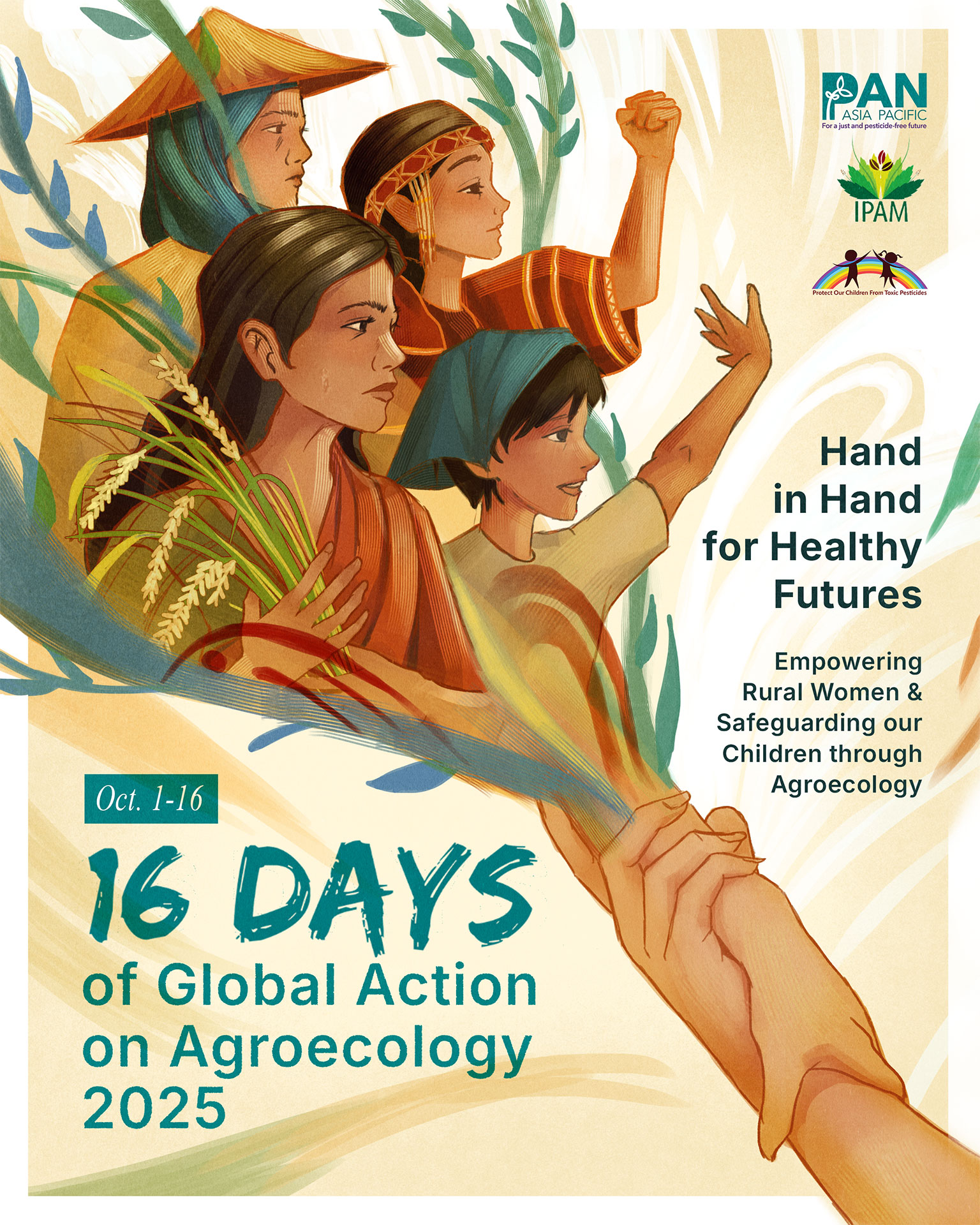
In 2025, the campaign will focus on the Protect Our Children (POC) from Toxic Pesticides campaign, with the theme “Hand in Hand for Healthy Futures: Empowering Rural Women & Safeguarding Our Children through Agroecology”, linking the global call to secure safe and sustainable food systems (World Hunger Day) with the crucial role of rural women (International Day of Rural Women) in shaping agroecological solutions. By focusing on children’s health, this campaign underscores the urgent need to phase out hazardous pesticides and replace them with agroecological practices that restore ecosystems, build community resilience, and ensure a healthy, poison-free future for the next generation.
Children are among the most vulnerable to the harmful effects of pesticides. Due to their smaller body size and rapid development, they breathe more air, consume more food, and drink more water per unit of body weight compared to adults, making them more susceptible to toxic exposures. Pesticide exposure during early childhood can interfere with brain development, damage the nervous system, and hinder both physical and cognitive growth. Scientific studies have linked long-term exposure to pesticides with childhood cancers, autism, learning disabilities, hormonal disruption, and a reduction in IQ.
Around 108 million children are involved agriculture1, and according to ILO and UNICEF, an alarming
83.4 million (61%) child labour are in the agriculture sector2, many of whom are directly or indirectly exposed to hazardous pesticides in the fields where they live or work. This alarming statistic underscores the urgent need for systemic change in how food is produced and how children are protected from toxic chemicals.
Crucially, the campaign also centres on the role of rural women and girls, who are key to food production, biodiversity conservation, and caregiving in their communities. Despite their central roles, rural women and girls are disproportionately affected by the harmful impacts of pesticides due to gender-based labour divisions and limited access to healthcare, education, and land rights. Many are directly exposed during farming tasks or indirectly while collecting water, preparing food, or caring for family members affected by pesticide poisoning. Girls working in agriculture also face both pesticide exposure and the compounding vulnerabilities of gender and age discrimination.
Agroecology offers tangible alternatives through regenerative practices that eliminate pesticide dependence, restore soil and water health, and strengthen biodiversity. Implementing agroecology in homes, farms, and schools not only protects children from toxic exposure but also empowers rural women, often primary caregivers and food producers, to lead community-based change. Through this campaign, PANAP and its partners aim to inspire action, influence policies, and build a wider movement for safe, sustainable, and just food systems.
Goals & Objectives Overall Goal
Protect women’s rights, children’s health and the environment by promoting agroecological practices and reducing pesticide exposure, while highlighting the vital role women play in advancing agroecology.
Objectives
- Raise awareness among community members; especially parents, youth, rural women, and local leaders, about the health risks pesticides pose to children and ecosystems, thus demanding a healthy, pesticides-free environment for the children.
- Demonstrate agroecological alternatives in farming communities, involving women, reducing dependence on toxic pesticides.
- Mobilise policy influence across several countries to strengthen regulations on pesticide use, and to support and promote agroecology especially in agriculture.
Our Main Calls and Demand
- Youth of the world unite for food, land, and climate justice!
- Agroecology and food sovereignty for climate justice now!
- Agroecology, not false climate solution!
- Land and subsidies for people-led agroecology!
- Phase out Highly Hazardous Pesticides!
- Fight for Just, Equitable, Healthy and Sustainable Food Systems!
- Women Rise Up! Fight for Food, Land and Climate Justice!
How can you join?
- Share creative videos of children and communities calling for a #PesticidesFreeWorld #AgroecologyNow through drawings and messages.
- Organize events (e.g. biking, storytelling, gardening, organic markets) involving children and youngsters to highlight children’s need for a healthy, pesticides-free environment and to promote agroecology.
- Urge your policymakers to support the phase-out of HHPs and promote their replacement with agroecological alternatives. Mobilise support through petitions and encourage your policymakers to endorse and develop strong policies that advance agroecology. At the same time, PANAP invites your organisation to support and endorse our call for pesticide-free buffer zones of at least 1 km around schools. We encourage you to sign and share our global petition here: https://chng.it/H7KfRDCffY.
- Print the 16 Days poster, cover photo and placards with our calls and demand, use them in your events and activities and take a photo. Tag us on Facebook & Twitter (@PANAsiaPacific) and Instagram (@justpesticidefreeasia)! Use the following hashtags: #PesticidesFreeWorld #AgroecologyNow
(1) Poster in PNG file (10.2MB)
https://files.panap.net/resources/16-Days-2025-Poster.png
(2) Cover photo on PNG file (2.7MB)
https://files.panap.net/resources/16-Days-2025-Cover-Photo.png
(3) Placards on PNG
https://drive.google.com/drive/folders/17gm-kRHueHr0pEGalrGUyNGrg4vYc5Yl?usp=sharing
(4) Media Kit on ZIP file (145MB)
https://files.panap.net/resources/16-Days-2025-Kit.zip
Contains a PSD file of the Poster and Cover Photo, including logos and fonts
(5) On Canva, make a copy and edit these files:
(a) Poster: https://www.canva.com/design/DAGycxpX6nE/W7YAOvDC4hAeLQqPI8rbAA/edit?utm_content=DAGycxpX6nE&utm_campaign=designshare&utm_medium=link2&utm_source=sharebutton
(b) Cover Photo:
https://www.canva.com/design/DAGyc3EMR-Y/XJg5HzbiGR9N52D_uB56mg/edit?utm_content=DAGyc3EMR-Y&utm_campaign=designshare&utm_medium=link2&utm_source=sharebutton
(c) Placards:
https://www.canva.com/design/DAG0oGdcfR4/qupW0SCIKatz681bLilqGw/edit?utm_content=DAG0oGdcfR4&utm_campaign=designshare&utm_medium=link2&utm_source=sharebutton
The 16 Days of Global Action on Agroecology and POC aligns with global and regional environmental and child protection goals by merging agroecology, community engagement, and policy advocacy in a powerful 16-day action window. It leverages PANAP’s regional networks, International People’s Agroecology Movements (IPAM) and Field Learning Sites (FLS) platforms, and Community-based Pesticide Action Monitoring (CPAM) reports to catalyse change at farm, school, and policy levels, ensuring that children’s health and biodiversity thrive together. Join us from 1–16 October 2025, to safeguard our children, restore our ecosystems, promote agroecological practices and demand a pesticide-free future.
If you’re interested in joining or have any questions, feel free to contact Dinesh Rajendran at dinesh@panap.net
__________________________________________________________________
1 United Nations Children’s Fund. (2021). Healthy Environments for Healthy Children: Global Programme Framework. UNICEF. New York.
2 International Labour Organization & United Nations Children’s Fund. (2025). Child Labour: Global estimates
2024, trends and the road forward. ILO and UNICEF. New York.








Discussion about this post