
In almost five decades, imperialist powers—headed by the United States and institutions such as the International Monetary Fund, World Bank, and World Trade Organization—have imposed neoliberal restructuring throughout the Global South. Carried out by compliant neo-colonial states, these policies have eroded public support for agriculture, deregulated land and resource governance, and pried open rural economies to transnational corporations.
In the Asia-Pacific, the result has been intensified land dispossession, the erosion of food sovereignty, and the worsening of rural poverty and inequality.
The sharpening geopolitical rivalry—most notably between the United States and China—has further accelerated land and resource grabbing, cloaked in the language of development, climate solutions, and energy transition. Mega-infrastructure and extractive projects including railways, dams, large-scale renewable energy installations, and mining operations—have caused widespread displacement, environmental damage, livelihood loss, and human rights violations. Wars of aggression loom as the US asserts its hegemony in the face of decline. Throughout the region, rural communities and Indigenous Peoples continue to bear the socio-economic and ecological costs of this intensifying imperial competition.
In the Philippines, land grabbing has accelerated in recent years amid policy shifts that further open land and natural resources to foreign capital. The recently enacted 99-year land lease scheme (the “Act Liberalizing the Lease of Private Lands by Foreign Investors”) effectively grants foreign entities and corporations long-term control over Philippine land, favoring powerful external interests. Imperialist countries are poised to exploit these arrangements to intensify land monopolization and resource extraction. Already, over 30,000 hectares of agricultural land have been earmarked for solar, wind, and geothermal energy projects, often without the free, prior, and informed consent of affected rural communities. Marketed as “green,” these projects have displaced small farmers and fishing communities while prioritizing corporate profit over domestic food production. At the same time, indigenous and peasant communities brace for the impacts of the critical minerals deal between the U.S. and the Philippine government, which further opens the country’s strategic resources to foreign control and advantage.
In Indonesia, the US$653 million World Bank-funded Integrated Land Administration and Spatial Planning (ILASP) project approved in late 2024, aims to strengthen land tenure security and promote climate-informed spatial planning. However, critics argue the project risks reinforcing elite land control under a reform framework. Groups such as The Oakland Institute describe it as “climatewash,” warning that land formalization could ease corporate access to land and high-carbon areas. This WB project also includes weak safeguards for indigenous and communal territories, limited institutional capacity within ATR/BPN, and inadequate guarantees of free, prior, and informed consent, potentially deepening dispossession rather than preventing it. At the same time, Indonesia’s palm oil industry has displaced an estimated 1,000 Indigenous communities, with over 16 million hectares of land allocated to plantations. An ambitious “eco-tourism” mega-park is also in the works in Lombok, Indonesia. Called “Mandalika Project,” this aggressive tourist development project will cover 1,179 hectares of Indonesia’s coastal area.
In North-East Asia, particularly in Mongolia, large-scale mining has severely affected pasturelands, undermining nomadic herding livelihoods and contaminating water sources vital for food production. By 2025, the country’s mining-driven economic model continues to intensify land degradation and water scarcity, with an estimated 72% of land degraded and more than 100,000 hectares directly impacted by mining activities. The expansion of the Oyu Tolgoi project, operated by Rio Tinto, has been linked to widespread displacement of herders and the loss of critical grazing areas. These pressures are compounded by increasingly severe dzud (extreme winter) events, which have killed over 8 million livestock in recent years, deepening ecological and socio-economic crises.
In South Asia, the Pakistan Kissan Mazdoor Tehreek (PKMT) leads the protest against the Green Pakistan Initiative (GPI), as it facilitates massive state-sponsored land grabbing for corporate farming, displacing thousands of small farmers in Punjab and Sindh.Under the Green Pakistan Initiative, about 4.8 million acres (or almost 2 million hectares) of state land were identified for corporate agriculture, with roughly 900,000 acres (or about 364 thousand hectares) already leased out, leading to forced evictions.
Similar patterns exist in India and Sri Lanka, where special economic zones, corporate farming schemes, and infrastructure corridors have dispossessed peasants and weakened customary land tenure systems. In Central India, the Modi government has unleashed an all-out war against the Adivasi people, who stand as the final line of defense for the Abujmaahd mountain range against corporate plunder. Rural communities now endure a state of heavy militarization as the counter-insurgency program Operation Kagaar intensifies its campaign, resulting in a documented escalation of killings. This killing spree is designed to clear the forests of its people before the mineral-rich soil is handed over to industrial giants–driven by the government’s aggressive mandate to reach a “zero Naxalite” target by the looming deadline of 31 March 2026.
Across the region, landlessness does not only produce rural poverty, it produces migration, displacement, and new forms of labor exploitation. Millions of peasants, small farmers, fisherfolk and Indigenous peoples forced off their lands are compelled to migrate internally and across borders in search of survival. Rural dispossession feeds the global labor migration system, transforming food producers into low-wage migrant workers in plantations, construction, fisheries, domestic work and manufacturing sectors. Many become undocumented or trapped in debt bondage, forced labor and trafficking, while women face heightened vulnerability to gender-based violence and exploitation.
At the same time, conflict over land and resources, climate disasters, and development aggression have created protracted refugee and displacement situations. Refugees and asylum seekers, unable to access land and livelihood, are pushed into precarious informal labor and chronic food insecurity. Thus migrants, refugees and displaced peoples are not separate from the agrarian crisis , they are its human consequence. The struggle for genuine agrarian reform is therefore also a struggle for the right to remain, the right to return, and the right to dignified mobility.
As people resist these neoliberal onslaughts and continue to defend their land and territories, states and corporations are doubling down on the multistakeholder model to exert joint control through the United Nations and its agencies, such as the Food and Agriculture Organization (FAO). Such a framework limits the transformative or groundbreaking change of initiatives like the 2nd International Conference on Agrarian Reform and Rural Development (ICARRD+20), held February in Cartagena, Colombia, even when packaged as spaces for civil society to reclaim agrarian reform.
In the two decades since the first ICARRD, the international community has moved toward recognizing land and tenure security through instruments like the 2007 United Nations Declaration on the Rights of Indigenous Peoples (UNDRIP) and the 2018 UN Declaration on the Rights of Peasants and Other People Working in Rural Areas (UNDROP); however, these remain non-binding and are frequently superseded by national legislation. Meanwhile, global hunger remains above pre-pandemic levels and the climate crisis has intensified. While largely an initiative of the Colombian government, ICARRD+20 and its outcomes are confined within the UN framework that aligns land policy with the Sustainable Development Goals (SDGs) and the neoliberal climate agenda—primarily to accelerate investment flows promoted by the IMF and World Bank. Ultimately, ICARRD+20 is unlikely to halt green grabs or resolve the food crisis, especially as rights-based instruments like the VGGT, UNDRIP, and UNDROP remain constrained by voluntary state compliance.
This systemic fragility is further exposed as the practicality of such events and instruments is called into question amid active wars of aggression. US-Israel warmongering in West Asia is escalating, following the ongoing strikes against Iran and years of a genocidal war against Palestine.
Peasants are not at the waiting end of these hollow commitments. Across Asia, peasant movements are already advancing genuine agrarian reform and sustainable agriculture. In the Philippines, the Kilusang Magbubukid ng Pilipinas has expanded the bungkalan—collective land cultivation—allowing organized landless farmers to reclaim idle estates and produce food for their communities while relearning sustainable agriculture and practicing agroecology, seed sovereignty, and climate-resilient farming. Similar agroecological initiatives are advancing in Pakistan where PKMT members actively collect, regenerate, and exchange indigenous seeds for wheat, rice, and vegetables, resisting the reliance on commercial hybrid seeds. Members of PKMT from 16 districts across three provinces in Pakistan are now maintaining seed banks and ensuring that wheat, rice, corn, and vegetable seeds are grown not only for their own use but also for exchange among farmers in the communities and the wider PKMT community. They also focus on the role of women as crucial livestock and crop farmers, particularly against the corporatization of the dairy sector. In the same vein, an assertive land cultivation by the organization of the Southern Peasants Federation of Thailand has endured, leading toward sustainable and organized collective farming practices among southern Thailand farmers, particularly in agroecology. Another example is the Tamil Nadu Women’s Movement in India which has empowered women to collectively occupy land and convert it into productive agroecological farms.
These concrete struggles demonstrate that genuine agrarian reform and sustainable agriculture are not policy abstractions—they are living, people-led solutions to the land, food and climate crises perpetuated by imperialism.
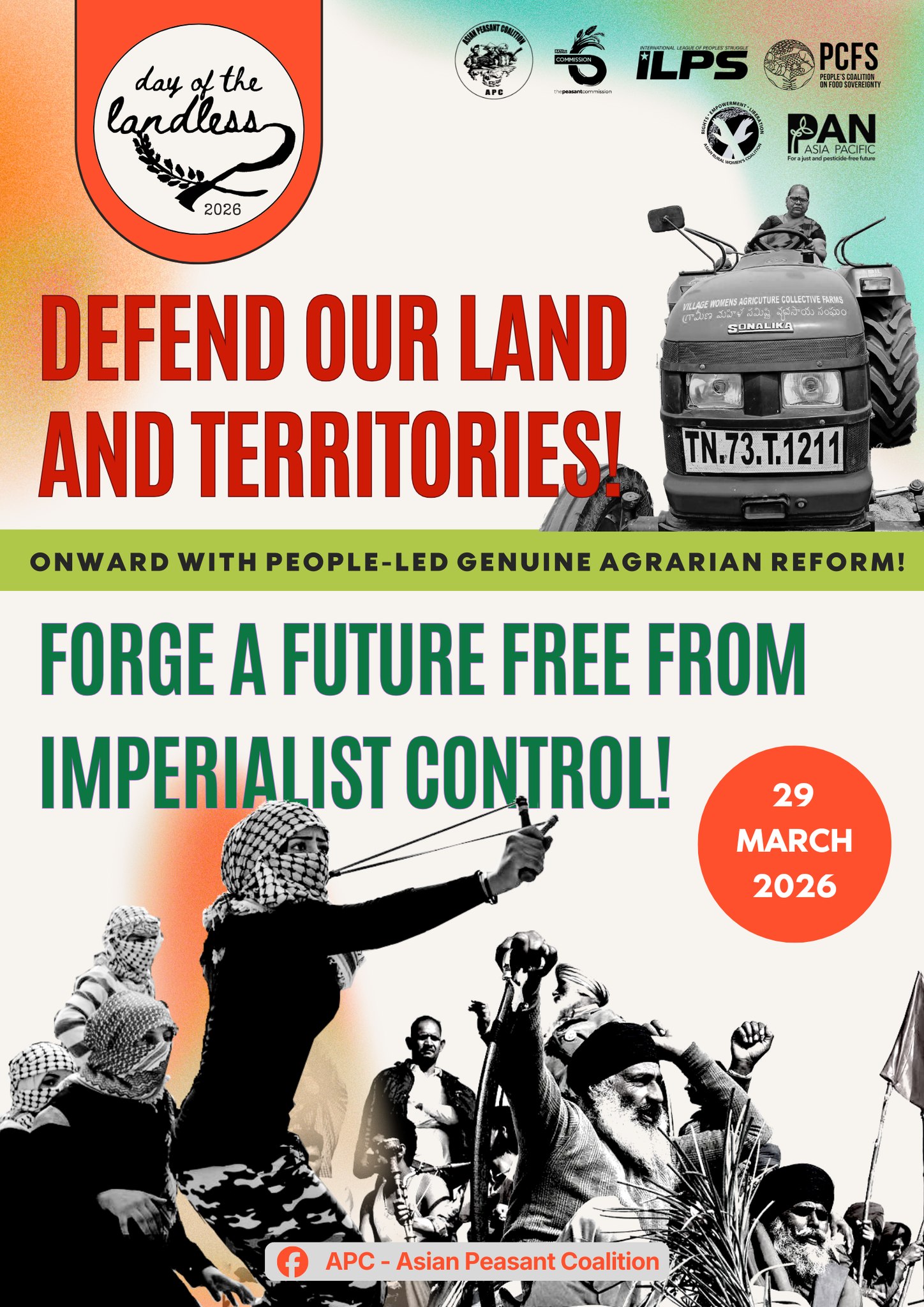
This 2026 Day of the Landless campaign will highlight the people-led efforts for genuine agrarian reform and sustainable agriculture while their communities battle against neoliberal policies and programs pushed by imperialist agents and institutions. This campaign will be a month-long with the first two weeks of March launching this in the social media platforms of the Asian Peasant Coalition and its international and regional networks. The 3rd week will feature on ground activities by APC members and partner networks while the last week leading to March 29 will feature mobilizations, pickets and other peasant-led actions.
The campaign will culminate in the Global Landless Speakout on March 29.
The Asian Peasant Coalition along with the International League of Peoples Struggle – ILPS Commission 6, People’s Coalition on Food Sovereignty – Global, Int’l Indigenous Peoples Movement for Self Determination & Liberation PAN Asia Pacific – PANAP, and the Asian Rural Women’s Coalition – ARWC jointly organize this year’s Day of the Landless 2026.
Join us as we organize a series of activities that bring to fore the peoples’ initiatives, victories, and struggles!
INITIAL ACTIVITIES
📅MARCH 8-14 – IN FOCUS: Land assertions across Asia
- Features land struggle happening in India, Indonesia, Mongolia, Philippines, Sri Lanka, Thailand, Pakistan, Palestine and others
📅MARCH 15-27 – On-ground Activities across networks
📅MARCH 28 – Global Day of Action against Operation Kagaar
- In solidarity with the international call to action against the Brahmanical Hindutva Fascist Indian state’s genocidal war on the people of India.
📅MARCH 29 – Global Day of Action for the Day of the Landless
- Join the Global Day of Action on March 29 to defend our land and territories and express solidarity with the landless people worldwide on-ground and online.
📅MARCH 30 – Palestine Land Day
🚩 HOW YOU CAN CONTRIBUTE
ORGANIZE mass actions/mobilizations at the community and/or country level to highlight your local land struggles.
POST CONTENT on social media as participation. These can be in the form of photos, videos, statements, graphic art, etc. that echo our calls for this year’s DOTL.
USE THE HASHTAG #DOTL2026 and #DayoftheLandless2026
USE DOTL 2026 LOGOS for your publicity materials (banners, social media posts, placards, shirts etc.) GDrive here: https://bit.ly/4s4AD0Q
Contributions will be featured during the Global Landless Speakout on March 29.
Stay connected by following APC and PANAP’s online platforms. For interest in collaborating with our campaigns, email at asianpeasantcoalition@gmail.com and info@panap.net
###