
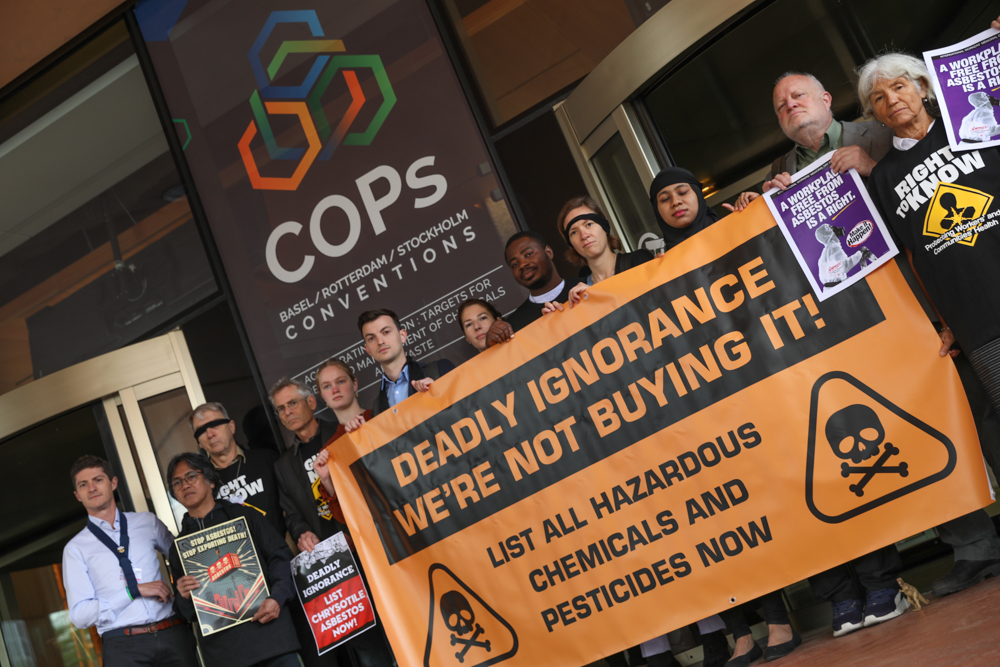
PAN Asia Pacific joins a global coalition of more than 40 trade unions and civil society organisations in an open letter calling on all Parties to the Rotterdam Convention to support an amendment to the Convention.
GENEVA—The Rotterdam Convention again remains paralysed by the tactics of Industry and a small group of countries, that block the listing of highly hazardous chemicals and pesticides, including chrysotile asbestos, that cause death and significant harm to human health and the environment.
The Rotterdam Convention is a critical tool for the safe and sound management of chemicals globally. Its Prior
Informed Consent (PIC) procedure ensures that countries have a RIGHT TO KNOW what highly hazardous
listed chemicals and pesticides are entering their country. This allows them to take appropriate regulatory
action to restrict or prohibit entry to safeguard the health of their citizens and the environment.
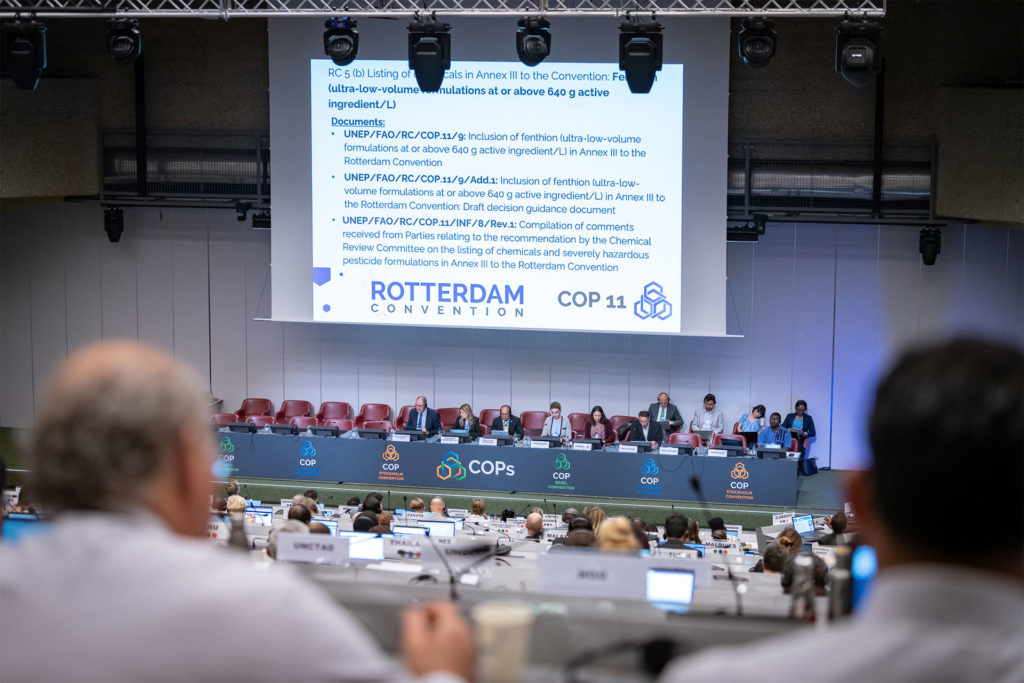
Prior to COP11, which is meeting this week in Geneva, there were 5 chemicals which met all the criteria for
listing, including the unanimous support of the Convention’s Chemical Review Committee, that remain
blocked for listing. This includes the highly hazardous chrysotile asbestos. Asbestos is one of the biggest killers
of workers globally and is responsible for the deaths of more than 200,000 workers every year. In addition to
chrysotile asbestos four pesticides–acetochlor, fenthion, paraquat and carbosulfan–remain blocked which cause significant harm to health of workers, particularly in developing countries. At this year’s COP the list of blocked chemicals continues to grow with the addition of another hazardous pesticide. These tactics highlight the increasing threat the Convention faces and reinforce the need for reform.
A global coalition of more than 40 trade unions and civil society organisations expressed their frustration and
dismay that again the Parties have failed to list chrysotile asbestos and other hazardous chemicals. These
blocking tactics threaten the viability of the Convention and make a mockery of its objective to warn countries
of the most dangerous chemicals entering their country.
In an open letter they are now calling on all Parties to the Rotterdam Convention to support an amendment to
the Convention which has been proposed by Australia, Switzerland and 12 other Parties[1], and which offers a
new simple solution to improve the effectiveness of the Convention, whilst protecting the consensus principle
at its core. It enables Parties who want to share information about hazardous chemicals to continue to do so.
If approved, the amendment will introduce a new pathway for listing chemicals, when the CRC has
recommended them for listing, but unanimous agreement to list them in Annex III cannot be reached by the
COP.
Recently three UN experts – Marcos Orellana, Special Rapporteur on toxics and human rights; David R. Boyd,
Special Rapporteur on human rights and the environment; and Pedro Arrojo-Agudo, Special Rapporteur on the
human rights to safe drinking water and sanitation – also issued a statement urging Parties to adopt the
amendment proposal.
The proposal to amend the Convention will be considered later this week and we demand all Parties
support the amendment.
In an intervention on behalf of PAN International, Alia Diyana, PANAP’s programme officer, expressed support for the proposal, citing the highly lethal pesticide paraquat as an example.
“Scientific experts on the Chemical Review Committee of the Convention have been recommending that certain formulations of paraquat be listed under Article III of the Convention since 2011. This science-based process has been blocked for fully 12 years by a tiny minority of Parties. New solutions are urgently needed…We ask all the Parties to prioritise the interests of their peoples over the interests of the powerful,” Diyana said.
“PAN urges all Parties to support the proposed amendments and restore the proper functioning of a critical international treaty in order to better protect people and the environment from hazardous chemicals,” said Dr. Sheila Willis, Pesticide Action Network UK.
“For too many years, a small number of States Parties have disregarded the recommendations of the Chemical Review Committee and blocked the listing of hazardous chemicals in Annex III. This has weakened the ability of the Convention to fulfill its core purpose,” said Marcos Orellana, Special Rapporteur on toxics and human rights.
See:
Open letter to the Rotterdam Convention
UN experts urge Parties to the Rotterdam Convention to adopt amendment
___________________________________________
[1] Australia, Burkina Faso, Colombia, Costa Rica, Georgia, Ghana, Nigeria, Norway, Peru, the Republic of Maldives, South Africa, Switzerland, Togo and the United Kingdom






 Pesticide Action Network Asia Pacific
Discussion about this post