
The global food system today is the clearest expression of monopoly capitalism in agriculture. A handful of transnational corporations (TNCs), backed by the financial oligarchs, based in the imperialist centers of the Global North, as well as emerging imperialist power China, dominate every link in the chain of production—from lands, seeds and agrochemicals, to trading, processing, and retail.
The intense concentration of capital in the agri-food system is the structural outcome of imperialism: the highest stage of capitalism, where monopoly and finance capital rule, and where colonies and semi-colonies are subjugated and plundered to serve the profit needs of global capital. Technological innovation plays a crucial role in facilitating the further concentration of corporate power in the agri-food sector.
It is estimated that four to six dominant agri-food TNCs hold more economic power than the world’s 3.6 billion farm families, fishers, and other small food producers put together. But within these four to six dominant agri-food TNCs, there are two to three super-dominant financial oligarchs that have interests across competing monopolies.
In 2024, the aggregate revenue of the top 10 agribusiness companies is approximately USD 769 billion, which is higher than the combined economies of all 50 poorest countries in the world. For further illustration, the revenue of Cargill, the US-based TNC that is the world’s largest agri-food commodity trading firm, is 62 times larger than the economy of South Sudan. Such skewed concentration of wealth and power has created very sharp contradictions between the world’s richest agri-food capitalists and rural working peoples.
At current levels of production, the global agri-food sector can feed up to 10 billion people – way beyond the total world population of eight billion. Yet, there are an estimated 673 million hungry people worldwide as of 2024, with 2.3 billion people experiencing food insecurity, most of them, ironically, are the farmers and rural peoples who directly produce the world’s food. Based on various estimates, almost 25,000 people die every day because of hunger, 295 million people are in an acute food crisis, and 1.3 million are in famine-like conditions.
The problem is not the lack of food. People are hungry and food insecure because they are poor, and billions are poor because imperialist monopoly control over the agri-food system has dislocated them from the means of agri-food production, including land and other productive resources. On top of and aggravating this underlying oppression and exploitation of working peoples are the collapse of the planet’s biodiversity, climate crisis, and wars, which are all caused and driven by the plunderous and anarchic nature of imperialism.
Monopoly capital in food and agriculture
Monopoly is the inevitable outcome of capitalist development, borne out of never-ending competition to dominate markets, accumulate the greatest capital, and earn the most profits in the fastest way possible. Today, some of the world’s most dominant monopolies are found in the global agri-food sector. According to recent research by the ETC group released earlier this year, oligopolies—meaning just four companies controlling 40% or more of the market—exist in four agri-food sectors: commercial seeds, pesticides, farm machinery, and animal pharma. Oligopoly also exists in agricultural commodity trading.
Monopoly control is most pronounced in the commercial seeds and pesticide industries, wherein the same four TNCs dominate, namely Syngenta of China and Switzerland, Germany’s Bayer and BASF, and Corteva of the US. The US, China, and Germany are, of course, the world’s three largest economies and leading imperialist powers.
As of 2023, the Big Four accounted for 56% of the global commercial seeds market, valued at more than USD 27.9 billion, and 61% of the global pesticides market, valued at almost USD 48.5 billion. The top TNCs in each sector – Bayer in the commercial seeds sector and Syngenta in the pesticides sector – account for a quarter of their respective markets.
Capitalism is all about the creation of bigger monopolies, and this is clearly illustrated in the global agri-food sector over the decades. In the 1960s to the 1980s, the four biggest TNCs in the commercial seeds sector (the same top four TNCs today) accounted for 18% to 26% of the market. Between the 1990s and 2020s, as these corporate giants acquired competitors through multi-billion-dollar mergers and acquisitions, the market share of the top four TNCs increased from 38% to 61%.
The same pattern of increasing concentration is observed in the pesticides sector. From 14% to 21% in the 1960s to 1980s, the market share of the four biggest pesticide TNCs jumped to 43% to 56% in the 1990s to 2020s.
The concentration of seed and pesticide corporations under the same TNCs is a natural result of the capitalists’ need to consolidate and expand their control over the market and secure their profits. Controlling the seed market also ensures a lucrative market for pesticides. Technological innovations—such as genetically engineered seeds and digital tools that increase dependence on pesticides—are fueling industry consolidation and strengthening monopoly control.
Aside from seeds and pesticides, intense monopoly control is also pronounced in other sectors of the agri-food system. Global agricultural commodity trading, for instance, is another sector in the agri-food system where there is a very top-heavy concentration of market dominance. The top four agricultural trading companies, namely Cargill, Archer Daniels Midland (ADM), and Bunge of the US, and Louis Dreyfus of the Netherlands, dominate nearly 60% of the global agricultural trading volume, based on 2021 and 2024 data, with integrated supply chains spanning from sourcing to processing.
Meanwhile, in the farm machinery sector, the top four companies, based in the US, Europe, and Japan, control 43% of the market as of 2023, as reported by the ETC Group. Similarly, in the animal pharma industry, the four biggest companies based in the US and Germany control 49% of the market. There is less, but still significant, concentration in the synthetic fertilizer sector, with the top four firms cornering a quarter of the market.
In earlier research using 2020 sales data, the ETC Group also reported that the top 10 TNCs from the US, Switzerland, Brazil, Belgium, and France control 34% of the global market of food and beverage processing. US-based food and beverage processors account for 57% of the total sales of the top ten. In grocery retailing, US-based TNCs account for 47% of the total sales of the top 10, with Walmart accounting for almost 30 percent.
Role of financial oligarchs
To fully understand the extent and concentration of monopoly control in the agri-food system, we must not only look at the leading TNCs in its various sectors. More crucially, we must investigate the source of capital that is bankrolling these TNCs’ operations. Under imperialism, industrial capital (factories, production) and bank capital (finance, credit) have merged as finance capital. The concentration of finance capital in the hands of a few capitalists gave rise to the financial oligarchy, the super elite at the very top of the imperialist pyramid.
The governance of the global agri-food system, thus, is increasingly shaped not only by the agribusiness corporations that directly manage production, processing, and distribution, but by the financial oligarchs who concentrate ownership and capital across the sectors. These investors—asset managers, banks, sovereign wealth funds, private equity firms, and hedge funds—do not typically control the day-to-day operations of agribusiness firms. However, through concentrated shareholding, financing, and speculative activities, they exert structural influence over the strategic directions of the world’s largest food and agricultural corporations.
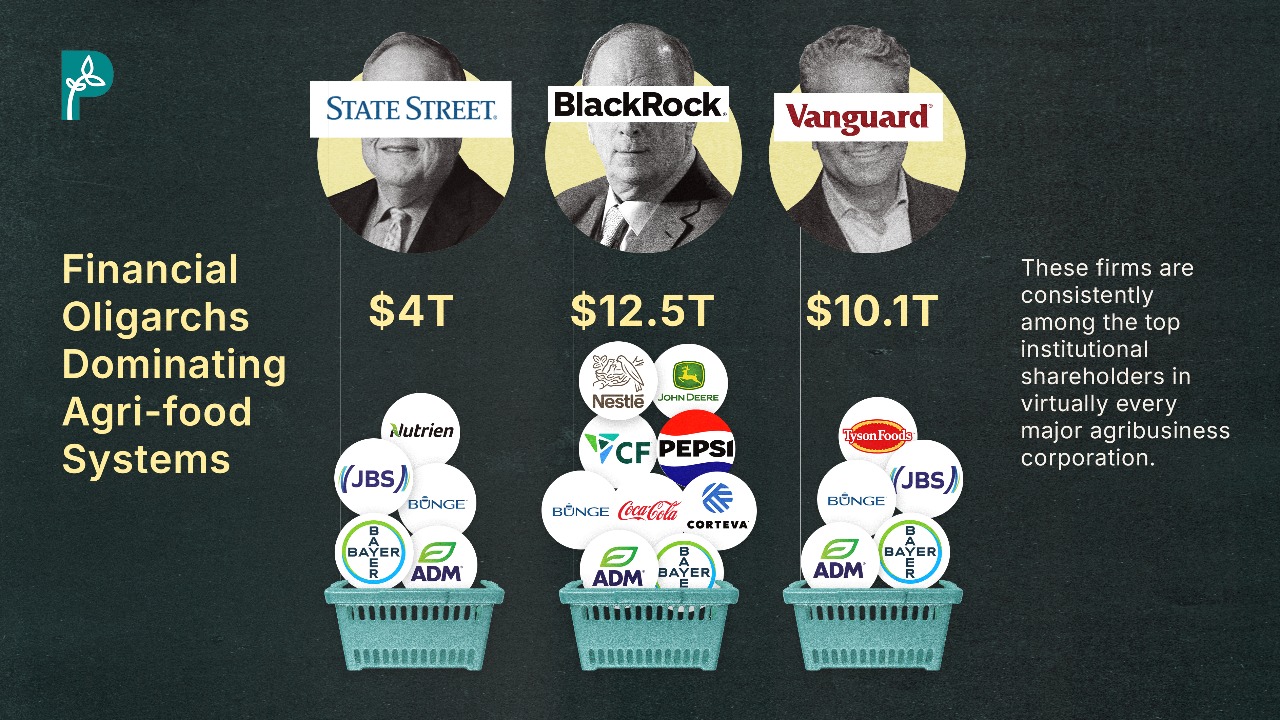
The most prominent financial oligarchs are the so-called “Big Three” asset management firms, all based in the US—BlackRock, Vanguard, and State Street Global Advisors. These firms are consistently among the top institutional shareholders in virtually every major agribusiness corporation.
- BlackRock manages approximately USD 12.5 trillion in assets as of June 2025, making it the largest asset manager in the world. It holds significant stakes in corporations such as Bayer (including Monsanto), Corteva, Archer Daniels Midland (ADM), Bunge, Tyson Foods, Deere & Co., Nestlé, PepsiCo, Coca-Cola, and fertilizer producers including Nutrien and CF Industries.
- Vanguard Group, with an estimated USD 10.1 trillion in assets under management (AUM) as of April 2025, maintains extensive holdings in ADM, Bayer, Corteva, Bunge, Deere & Co., and leading meat processors such as Tyson and JBS. It is frequently the second or third largest shareholder after BlackRock.
- State Street Global Advisors, although smaller at around USD 4 trillion AUM, remains among the top five shareholders in Bayer, ADM, Bunge, JBS (Brazil’s meat giant), and Nutrien, among others.
For comparison, the combined assets of these three financial oligarchs (USD 26.6 trillion) are almost 17 times the combined economies of the world’s least developed countries (around USD 1.57 trillion). Collectively, they control 15–25% of the shares in leading agribusiness corporations. While they do not directly manage operations, their voting power and capital concentration enable them to shape corporate governance, mergers and acquisitions, and long-term strategies.
Along with asset management firms, global investment and commercial banks play a parallel role by financing agribusiness operations and treating agricultural commodities as financial assets.
- Goldman Sachs, JP Morgan, Morgan Stanley, and Citigroup – all based in New York – are deeply involved in commodity index funds that speculate on food staples (wheat, corn, soy, rice). Their activities were a significant factor in the 2007–2008 global food crisis, when speculation drove dramatic price volatility. These banks also provide loans, trade finance, and hedging services to corporations such as ADM, Bunge, and Cargill.
- Rabobank of the Netherlands is the world’s largest food and agribusiness lender. It plays a critical role in financing livestock and dairy supply chains and has been linked to funding deforestation-driven agricultural expansion in Brazil and Southeast Asia.
- European banks, including BNP Paribas, HSBC, Barclays, and Deutsche Bank, are major financiers of fertilizer and agrochemical producers (e.g., BASF, Yara, Nutrien) as well as meatpacking giants in Brazil such as JBS, Marfrig, and BRF.
The financialization of agri-food also saw the deep entrenchment of sovereign wealth funds, public investors, private equity, and hedge funds in the sector. Norway’s Government Pension Fund Global (GPFG), the world’s largest sovereign wealth fund, for example, has invested billions of dollars in multinational corporations such as Nestlé, Unilever, Bayer, PepsiCo, ADM, and Bunge. Public investor China Investment Corporation (CIC) supported ChemChina’s acquisition of Syngenta, consolidating one of the world’s largest agrochemical corporations under Chinese state monopoly capitalism.
Alongside sovereign wealth funds, private equity and hedge funds have also entrenched themselves in the sector by pursuing profit through consolidation, speculation, and farmland acquisition. These financial firms actively acquire and consolidate food processors, restaurant chains, agri-technology companies, and even farmlands worldwide.
Commodification of land
The growing concentration of finance capital in the agri-food system, controlled by financial oligarchs, is accelerating the commodification of farmland. Instead of being used productively for food production and livelihoods, much of this land is being turned into speculative assets for investment and profit, which in turn is displacing large numbers of small farmers and other food producers.
Farmland historically appreciates in value and is less volatile than stocks or tech markets. After the 2008 financial crisis, farmland became highly attractive for wealthy individuals and institutional investors as a hedge, providing them the opportunity to diversify their assets. Additionally, in the context of the climate crisis, farmland is increasingly valuable not just for crops but for its potential role in carbon markets.
Thus, the world’s wealthiest individuals are directly taking over farmlands through investment firms. One of the most prominent examples is tech billionaire Bill Gates, who is now the US’s largest private farmland owner, holding an estimated 110,000 hectares through Cascade Investment LLC. Another is the Teachers Insurance and Annuity Association – College Retirement Equities Fund (TIAA-CREF), which has evolved from a pension fund into a global financial services corporation, managing assets worth over USD 1 trillion. Among such assets are over 800,000 hectares of farmland globally, including vast tracts of sugarcane and soy plantations in Brazil linked to deforestation and the displacement of local communities.
This trend is driving the further concentration of farmlands into the hands of big corporate interests. According to estimates, the largest 1% of farms operate up to around 70% of farmland worldwide, which is indicative of the state of landlessness and dispossession of the peasantry under monopoly capitalism.
National sovereignty, agrarian reform, food sovereignty
Colonialism drastically reshaped global agri-food production into what it is today, shifting agriculture to serve the needs of colonial powers rather than local food security and development. Colonies became sources of cheap raw materials for the colonizers’ industries and food supply, while also being flooded with surplus goods from the colonizers. Colonialism undermined local agriculture and food systems. Land and resources were seized from peasants and small producers, often taken over by colonialists and their local allies, such as big landlords and compradors. This was the first step in taking away the power to decide what to produce and how to produce from our farmers.
Centuries later, the colonial power imbalance between wealthy and poor nations remains. In the past 40 years, neoliberal globalization, including the liberalization of food and agriculture, has worsened this divide. TNCs working with local landlords and compradors have tightened their control over land, resources, and food production. Prioritizing global markets and trade, where they profit heavily, has come at the expense of domestic food security. We have become a dumping ground and market for TNCs’ expensive and toxic agri-food products and inputs, including agrochemicals. Land has become another commodity or asset for speculation and parasitic profit-making, not for food production and genuine development.
Thus, we must challenge and end the domination of colonial and imperialist powers in food and agriculture. Only then can food systems be transformed to prioritize domestic food security over global market interests driven by neoliberalism and TNC profits. To achieve this, the monopoly control of TNCs and local elites over land and resources must end. Genuine agrarian reform and rural development are essential for radically transforming food systems and meeting the needs of the people.
Farmers, producers, and consumers must campaign for and be part of a bigger anti-imperialist movement calling for national programs where farmers, not the TNCs and their local agents, have ownership and control over land and resources. Local food production for domestic consumption must be supported through state subsidies, price protection, and limits on foreign competition. With these foundations, other initiatives, like promoting agroecological farming over chemical-intensive, export-focused corporate agriculture, can be more easily implemented and expanded.
All these principles are encapsulated in what we call food sovereignty. It refers to the right of peoples, communities, and countries to determine their production systems that are ecologically, socially, economically, and culturally appropriate to their unique circumstances. It is different from food security, which neoliberalism distorted to mean the availability of food regardless of where and how they were produced, justifying unbridled liberalization, compromised public health, and the destruction of ecosystems. Food sovereignty is the power of people and their communities and countries to assert and realize their right to food, produce food, and fight the power of monopoly capital and other forces that destroy the people’s food production systems and deny them food and life. ###
Paper presented at the online forum “Land & Liberation: Resisting Tech-driven Imperialist Control over Agri-food Systems” organized by the International League of Peoples Struggles (ILPS), PAN Asia Pacific (PANAP), and Peoples Coalition on Food Sovereignty (PCFS) on August 22, 2025


 Pesticide Action Network Asia Pacific