
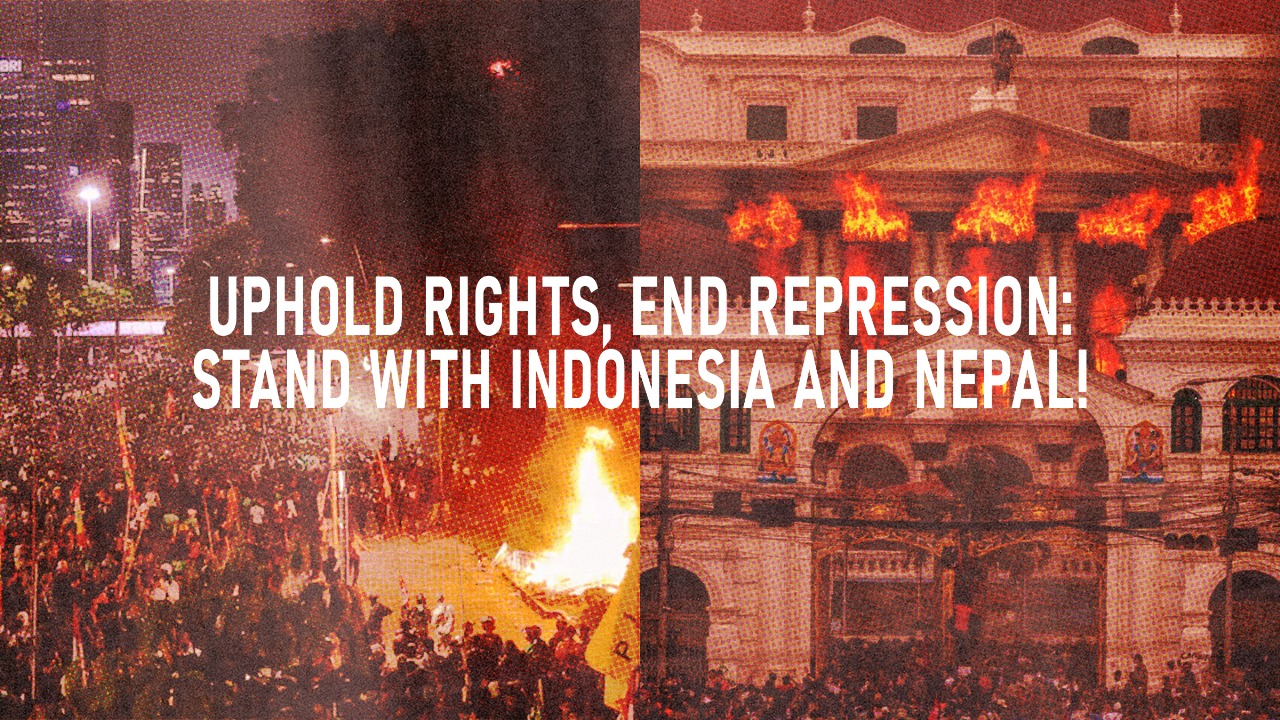
PENANG, Malaysia – Fifty-five movements, cause-oriented groups, and non-government organizations from at least 18 countries across the world came together to support the peoples of Indonesia and Nepal who are resisting repression, corruption, and policies that undermine rights, livelihoods, and dignity.
“Both countries are facing similar crises, rooted in the same issues: growing economic hardship, the decline of democratic and civic rights, and the failure of governments to hold themselves accountable to their people. Farmers are denied decent living, young people are denied a voice, and everyday communities are left to bear the weight of corruption, increasing costs, and oppressive measures,” the groups said in a joint statement.
Over the past few weeks, large protests led by young people, farmers, workers, and other groups have been sweeping Indonesia and Nepal, both fueled by increasing economic inequality and outrage over the concentration of wealth among the elite. In Indonesia, anger erupted after police killed a 21-year-old delivery driver on August 28 during protests against lawmakers’ lavish perks (i.e., USD 3,000 a month, 10 times the minimum wage) amid cuts to education, health, and public services. In Nepal, the government banned social media platforms on September 4, which critics viewed as an effort to suppress dissent amid viral trends exposing corruption and nepotism among officials’ families.
The groups noted that the protests in Indonesia and Nepal are taking place “amid widespread hunger and poverty and worsening global economic, political, and planetary crises”.
“In Indonesia, over 17 million people are still undernourished, with food insecurity reaching more than 50% in areas like Papua. In Nepal, a fifth of the population lives in poverty, a quarter of children under five are stunted, and more than 5 million people face food insecurity. These harsh realities reveal the gross failure of governments that neglect the interests of farmers, workers, young people, and other marginalized sectors, stoking up the anger now spreading through the streets,” the statement read.
More than 50 people were killed in Nepal while around 1,300 were injured during the protests. In Indonesia, over 3,000 were detained. Police forces used excessive force that further fanned the unrest. “We condemn the killings, violent dispersals, censorship, and systemic neglect that have inflamed these uprisings,” the groups said.
The groups called for justice and accountability for the victims of state violence, including through impartial probes; immediate economic policy reforms to address the rights, livelihoods, and dignity of farmers and other working peoples; an end to repression; and democratic governance that serves the needs of the marginalized rather than elite interests.
“Indonesia and Nepal’s struggles are linked to larger and broader peoples’ struggles across Asia and the world: a fight for democratic and collective rights to land, life, resources, livelihoods, and fundamental civil and political rights. We stand united with the peoples of Indonesia and Nepal in their struggle for justice, accountability, and dignity. Their voices transcend borders, fueling the global fight for human rights and sovereignty,” read the collective statement.
Of the groups that signed the statement, nine are global and regional networks or coalitions, while 45 are local and national community-based organizations, movements, development institutions, and other cause-oriented groups. Aside from groups based in Indonesia and Nepal, organizations from Australia, Bangladesh, Cambodia, India, Jordan, South Korea, Kyrgyzstan, Lebanon, Malaysia, Mongolia, Pakistan, the Philippines, Sri Lanka, Timor-Leste, and the US also signed the statement.
PAN Asia Pacific (PANAP), which has several partners in Indonesia and Nepal working on issues around agroecology, food sovereignty, and the right to land and resources, initiated the joint statement.
Read the full statement, along with the complete list of organizations that signed it, here. ###
For inquiries, contact Arnold Padilla, PANAP Deputy Executive Director, at arnold.padilla@panap.net.


 Pesticide Action Network Asia Pacific