

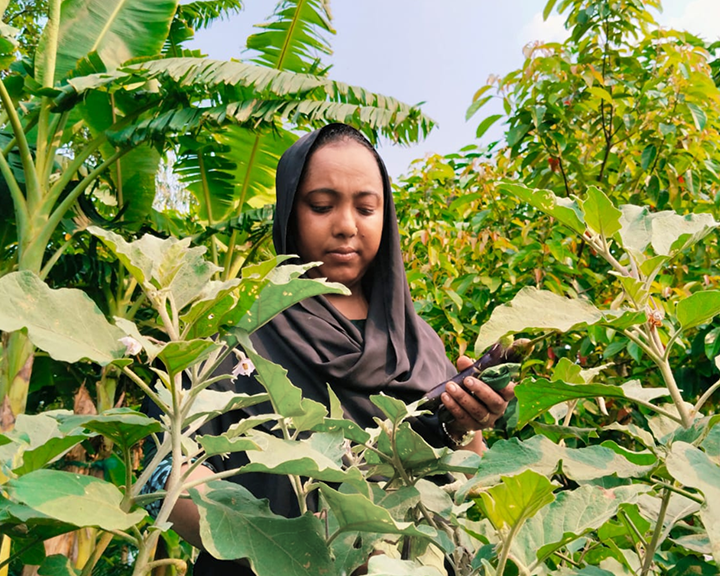
“As a community leader, I always try to share what I have learned with other women and encourage them to adopt agroecological practices to protect their families’ health and reduce dependence on harmful chemicals.” Yeasmin Akter is a farmer from Olipur, in Daudkandi, a rural district in the Cumilla region of Bangladesh, where a women-led agroecology movement has been taking root since 2021.
The Shikkha Shastha Unnayan Karzakram’s (SHISUK) community-led agroecology initiative in Daudkandi, Bangladesh has established 1,000 homestead gardens across 20 villages, with over 400 women driving a measurable shift away from chemical-dependent farming.
The Problem It Set Out to Solve
Bangladesh’s Green Revolution inheritance is particularly visible in Daudkandi. Decades of chemical-dependent farming have left soils degraded, pollinator populations diminished, and farming families exposed to health risks associated with pesticide use. Agroecology, farming that works with ecological processes rather than against them, has been slow to gain traction in Bangladesh, where research, policy support, and institutional adoption remain limited.
SHISUK’s response was to start small and start local. In 2021, working in partnership with Pesticide Action Network Asia Pacific (PANAP) through a Community Pesticide Action Monitoring (CPAM) programme, the organisation sent two women farmers, Chinu Rani Shingho and Kulsum from Chapatoli, Daudkandi to Thanal Trust in Kerala, India, for advanced agroecology training. It was a modest beginning to what would become a significant grassroots movement. In 2023 grant support from the Agroecology Fund led to the Community-Led Agroecological Homestead Farming Model.
Building from the Ground Up
“After returning [from Kerala], I first applied these practices in my own homestead so that people could see the results for themselves. Then I began visiting villages across Daudkandi and talking with women who were involved in homestead gardening and agriculture.” – Chinu Rani Shingho

The two women established pesticide-free demonstration plots in their own villages. These were not top-down model farms managed by external ‘experts’; they were community-managed spaces where neighbours could observe, ask questions, and learn. The approach worked. By 2022, the initiative had expanded to 20 ‘bio-villages’, each with a women’s group of 20 lead farmers responsible for driving the transition in their community.
The governance structure reflects this community-first orientation. Each bio-village committee takes responsibility for demonstration farming, seed banking, knowledge exchange, and market linkages. SHISUK operates as a technical partner and catalyst rather than a director.
What the Model Looks Like in Practice
At the centre of SHISUK’s model is a set of practices to help households transition from chemical-intensive agriculture to regenerative, nature-based systems. Women lead the work across four main areas: organic composting and vermicompost production, seed banking and exchange, natural pest and disease management, and diversified homestead gardening.
The homestead garden is at the center. Rather than monoculture plots reliant on purchased inputs, these gardens produce a range of vegetables and fruits using locally-made compost and natural pest management techniques. The surplus is sold to neighbours in the community using the participatory guarantee system (PGS), giving participating households a direct economic incentive to continue the transition.
Vermicompost (compost produced using earthworms) has become a small enterprise in its own right. Women produce and sell it independently, creating an income stream that is entirely within their control and directly tied to the ecological health of their soil.
Using the vermicompost, women also generate independent income from the sale of organic vegetables. Nutrition planning workshops have supported improved household food security alongside the shift in farming practice.
SHISUK has also developed Field Learning Sites: community-managed demonstration farms that function as knowledge hubs. These have attracted policymakers, NGO staff, university students, and neighbouring communities, extending the initiative’s reach well beyond its immediate network and turning participating villages into what the organisation describes as living classrooms for agroecology.
“Because (our families) have seen the vegetables growing in our garden and often help us take care of the plants, they are much more enthusiastic about eating them.”
– Kulsum

Women’s Leadership as Strategy, Not Tokenism
The initiative’s explicit focus on women’s leadership is not incidental. In communities where gender norms have historically constrained women’s roles in agricultural decision-making, SHISUK has made women’s agency the operational premise of the entire model.
The CPAM programme trains women facilitators to lead community campaigns aimed at reducing harmful pesticide use, drawing on their direct experience as farmers and as the people most consistently responsible for household food production. Leadership is not conferred from outside, it is built through practice and peer recognition.
A three-day residential leadership camp marked a significant moment in the initiative’s development. Women leaders from 14 upazilas (sub-districts) lived with farming families in Daudkandi, combining peer-to-peer learning with hands-on exposure to agroecological practice. The format, immersive, residential, farmer-to-farmer, was designed to build both technical knowledge and solidarity across the network.
To maintain connection across 20 bio-villages, SHISUK supports a digital knowledge-sharing platform where women exchange experiences, troubleshoot problems, and develop solutions collectively. By mid-2025, a self-sustaining mentorship cycle had taken hold: newer participants were actively aspiring to leadership roles, and experienced women farmers had taken on training responsibilities, gradually reducing the initiative’s dependence on external facilitation.
What Has Changed
The environmental results are measurable, if not yet fully quantified. Synthetic pesticide and fertiliser use has declined significantly across participating households. Soil fertility has improved through composting. Pollinator populations, including bees and other beneficial insects, are recovering in areas where chemical use had suppressed them. Indigenous seed varieties, many of them more resilient to local climate conditions, are being preserved and exchanged through the seed banking network.
Women farmers like Jhulon Rani came to understand the connection between pesticide exposure and declining health in their communities. The moment she learned about the long-term impacts of pesticides,she decided not to return to her previous farming practices.

What Comes Next
SHISUK is in the early stages of establishing an Agroecology Zone in Daudkandi, a dedicated area for safe food production and ecological restoration intended to serve as a replicable model. The organisation has also launched CEA-CAN, a network involving 13 local NGOs across 13 sub-districts, with plans for national expansion and eventual adaptation in other countries.
The numbers that defined the initiative at the outset; two women, one training programme, a handful of demonstration plots; have grown into something considerably larger. It is clear that in Daudkandi, the transition into a lasting agroecological approach to food production is already underway.
The Agroecology Fund is keen on supporting organizations like SHISUK in their journey towards an agroecological future!
Note: This article was produced by Agroecology Fund in collaboration with PANAP’s partner, Shikkha Shastha Unnayan Karzakram (SHISUK) Bangladesh. Edited by Pratyasha Ghosh from the Agroecology Fund. First published by Agroecology Fund.


 Pesticide Action Network Asia Pacific