
As the world marks the International Day of Rural Women during the UN-declared International Year of the Woman Farmer 2026, PAN Asia Pacific (PANAP) calls for more than recognition of women’s indispensable contributions to agrifood systems.
Rural women are farmers, food producers, agricultural workers, fishers, seed keepers, caregivers, organisers and knowledge-holders. Yet they continue to face landlessness, insecure and informal work, unpaid care, discrimination, hazardous pesticide exposure, and increasingly frequent and severe climate shocks. Floods, droughts, heat and other climate stresses deepen women’s workloads and undermine their livelihoods, health and food security. At the same time, chemical-intensive agriculture exposes women, agricultural workers and communities to toxic pesticides and deepens dependence on costly external inputs. As FAO (2026) has acknowledged, women’s unequal position in informal and low-paid work increases their exposure to pesticides and limits their ability to refuse hazardous tasks or afford protective equipment.
These burdens are rooted in an unjust agrifood system that concentrates control over land, seeds, markets and resources, while promoting agrochemicals, corporate agriculture and profit-driven technologies.
The International Year of the Woman Farmer is an opportunity to make rural women’s realities visible. But beyond celebrating their contributions, the structures that produce and perpetuate inequalities and injustices against rural women must be addressed. Rural women must be recognised as rights-holders, producers, workers, knowledge-holders and leaders with the power to shape their own food and agricultural systems.
Any discussion of rural women’s resilience must account for the disproportionate burdens they shoulder in times of climate and economic crises. Social protection must be guaranteed as a right, not treated as charity or a short-term safety net. Governments must invest in universal, gender-responsive social protection that provides security during crises, alongside decent work, healthcare, income security and rights to land and resources, especially for rural and agricultural workers.
Rural women are already building alternatives. Through agroecology, seed saving, diversified farming, community organising and collective action, they have been protecting biodiversity, reducing dependence on hazardous pesticides, strengthening local food systems and building collective resilience to climate shocks. Their knowledge and leadership must be supported and strengthened, not displaced by corporate-controlled technologies and top-down solutions.
Rural women are leading the movement for agroecology as a people-led alternative to corporate agriculture. They play a leading role in the struggle for food sovereignty, land and climate justice, and people’s control over food and natural resources.
As we mark the International Day of Rural Women and the International Year of the Woman Farmer, we stand with rural women who are not merely surviving crises but organising to transform the systems that create them. Their demand is clear: recognition of rural women must be founded on their rights to land and resources, safe and dignified work, freedom from toxic pesticides, climate justice, social protection, and the right to shape their own food and agricultural systems.
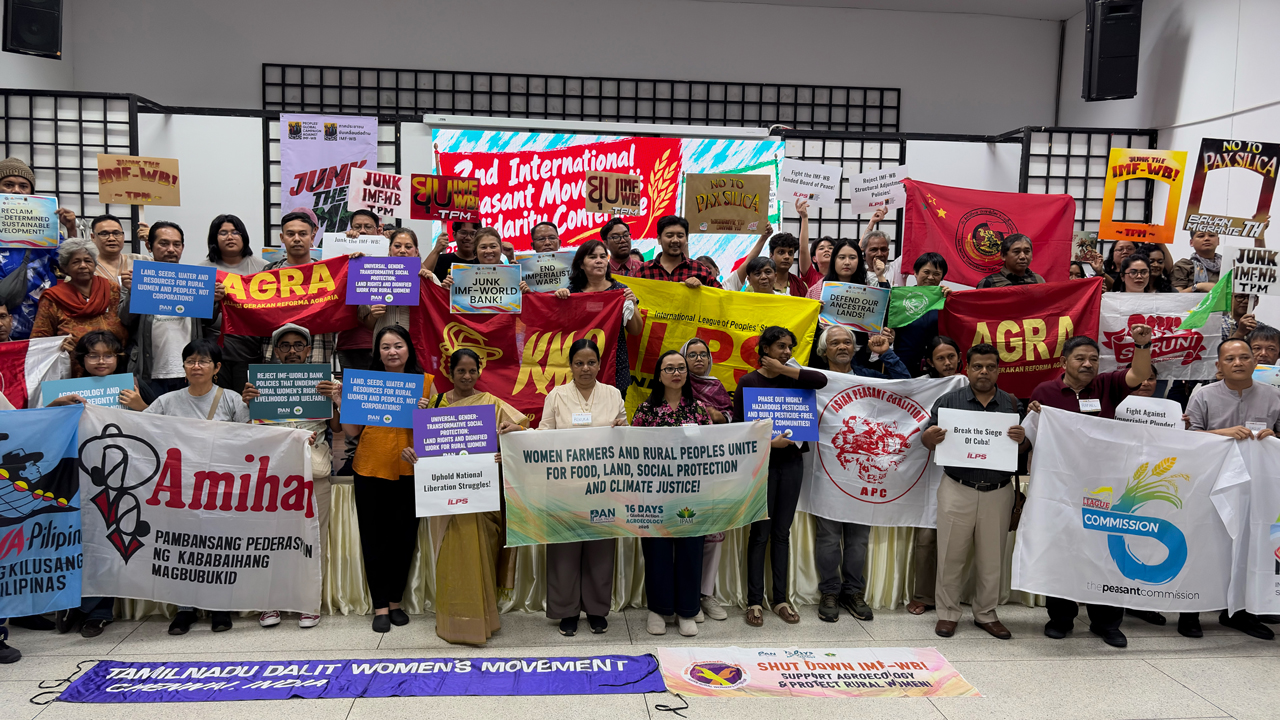
This message is at the heart of PANAP’s 16 Days of Global Action on Agroecology, under the theme “Unite, resist, transform: Rural women fighting for agroecology, food, land, and climate justice” held from October 1 to16. We reaffirm our commitment to support rural women, farmers, Indigenous Peoples, youth and communities across Asia and the Pacific in advancing food sovereignty and agroecology while challenging corporate control over food, land and resources. We call for a transformation of agrifood systems that puts rural women and communities—not corporations—at the centre.
Unite. Resist. Transform!
Advance people-led agroecology!
Protect rural women’s rights and knowledge!
Ensure universal social protection and dignified work!
Build agrifood systems rooted in food sovereignty, gender justice and climate justice!