
- Version
- 1 Download
- 7.27 MB File Size
- 1 File Count
- October 13, 2026 Create Date
- October 13, 2026 Last Updated
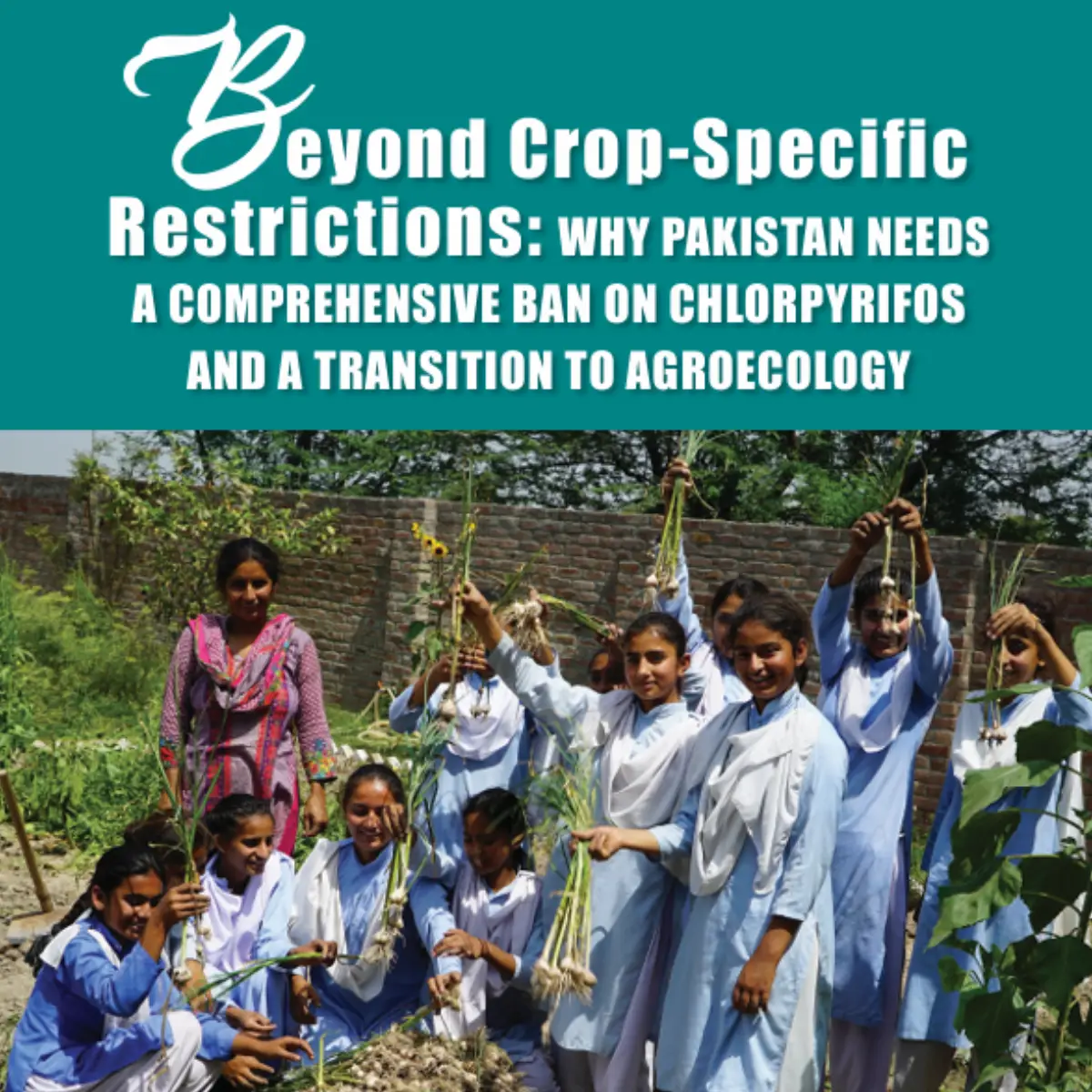
Chlorpyrifos is widely used in Pakistan’s agriculture and is also marketed for household insect control and termite management in residential environments. Despite growing international restrictions on the pesticide due to its neurotoxicity and environmental risks, imports and use remain significant. Trade data indicate that in May 2023 alone, Pakistan imported more than 16 tons of chlorpyrifos 40 % EC formulation and over 1,200 litres of formulations containing chlorpyrifos combined with cypermethrin (Volza, 2023).
Chlorpyrifos is an organophosphate insecticide widely used on major crops, including cotton, rice, vegetables and fruits for insect control. Although crop-wise data on its consumption are not publicly available, pesticide residue studies confirm its presence in a wide variety of crops across the country. These findings suggest that chlorpyrifos continues to be widely applied across Pakistan’s agricultural systems. While chlorpyrifos is classified as an organophosphate insecticide, it has also been recognized as a persistent organic pollutant (POP) due to its persistence, long-range environmental transport, and harmful impacts on human health and the environment. In May 2025, the Conference of the Parties to the Stockholm Convention on Persistent Organic Pollutants agreed to list chlorpyrifos under Annex A, requiring its global elimination, with limited time-bound exemptions for certain specific uses.
| File | Action |
|---|---|
| 1791894617wpdm_A4_Ban on Chlorpyrifos_2026_02.pdf | Download |