
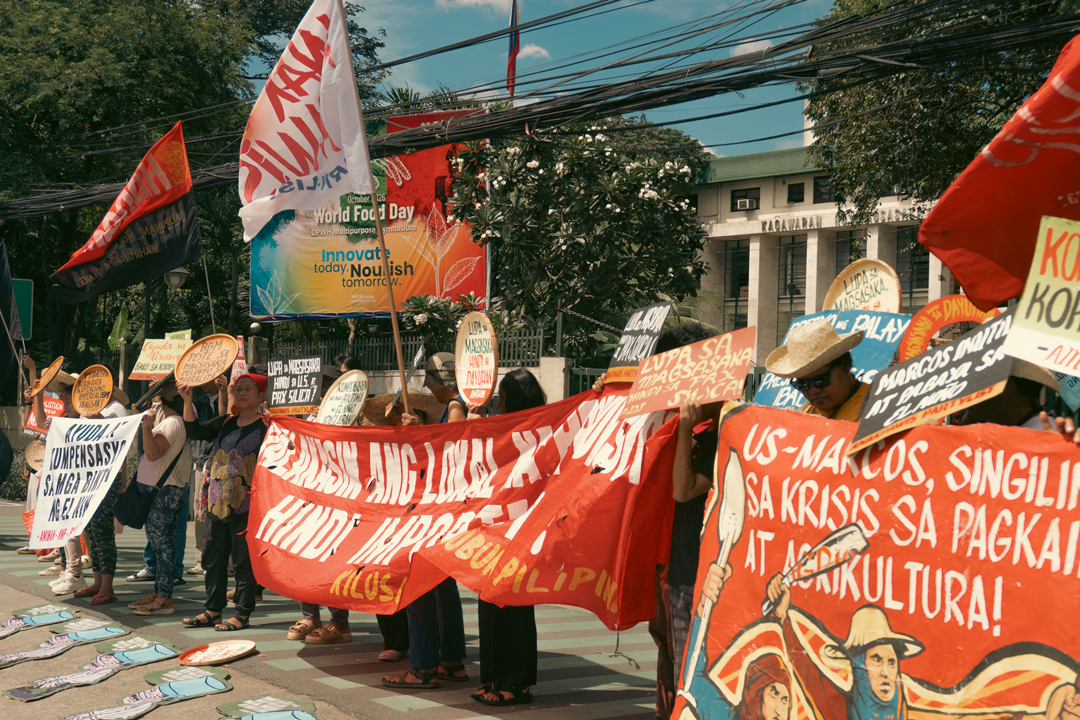
PENANG, Malaysia – On October 16, governments and international institutions mark World Food Day. But for millions of farmers, agricultural workers, fishers, Indigenous Peoples, and rural women, there is little to celebrate. We mark World Hunger Day to expose the injustice of a global agri-food system that condemns those who produce food to hunger.
The latest United Nations (UN) figures estimate that 645 million people endured hunger in 2025, while 2.1 billion experienced moderate or severe food insecurity. Despite enormous agricultural productivity, food remains beyond the reach of millions, with hunger deeply rooted in poverty, landlessness, dispossession, and the corporate concentration of resources and wealth.
The International Monetary Fund (IMF) and World Bank have helped reproduce these conditions through decades of policies that subordinate agriculture and people’s rights to creditors, global markets, and corporate profits.
The record stretches back to the Green Revolution. From the 1960s onward, governments and powerful foundations promoted high-yielding seeds alongside chemical fertilizers, toxic pesticides, and expensive irrigation. The World Bank financed agricultural modernization and helped establish the international research network CGIAR in 1971. While harvests increased, unequal access to land, credit, and technology meant the benefits were distributed unequally. Farmers became more dependent on purchased inputs, while industrial monocultures intensified ecological pressures.
The assault deepened with IMF–World Bank structural adjustment in the 1980s and 1990s. Indebted countries were pressed to cut public spending, dismantle agricultural subsidies, privatize services, and open food markets to imports. These structural reforms reflected a development model that exposed small farmers to unequal competition while constraining indebted countries’ ability to defend domestic food production. The liberalization and neoliberal restructuring of food and agriculture continue today.
The official World Food Day theme, “Innovate today. Nourish tomorrow,” begs a crucial question: Innovation for whom? A food system cannot be transformed merely by introducing new technologies while leaving corporate control over land, seeds, markets, and finance intact.
As PANAP’s 16 Days of Global Action on Agroecology culminate, we demand an end to IMF–World Bank conditionalities that undermine food sovereignty; debt justice and public investment in food production; genuine agrarian reform; protection of farmers’ livelihoods and fair prices; universal, gender-transformative social protection; and the phase-out of highly hazardous pesticides. Support and subsidize farmer-led agroecology, local seed systems, and community-controlled markets instead of corporate agriculture.
Food is a right, not a commodity reserved for those who can pay. Those who feed the world must never be condemned to hunger.
Reference: Sarojeni Rengam, Executive Director, PANAP